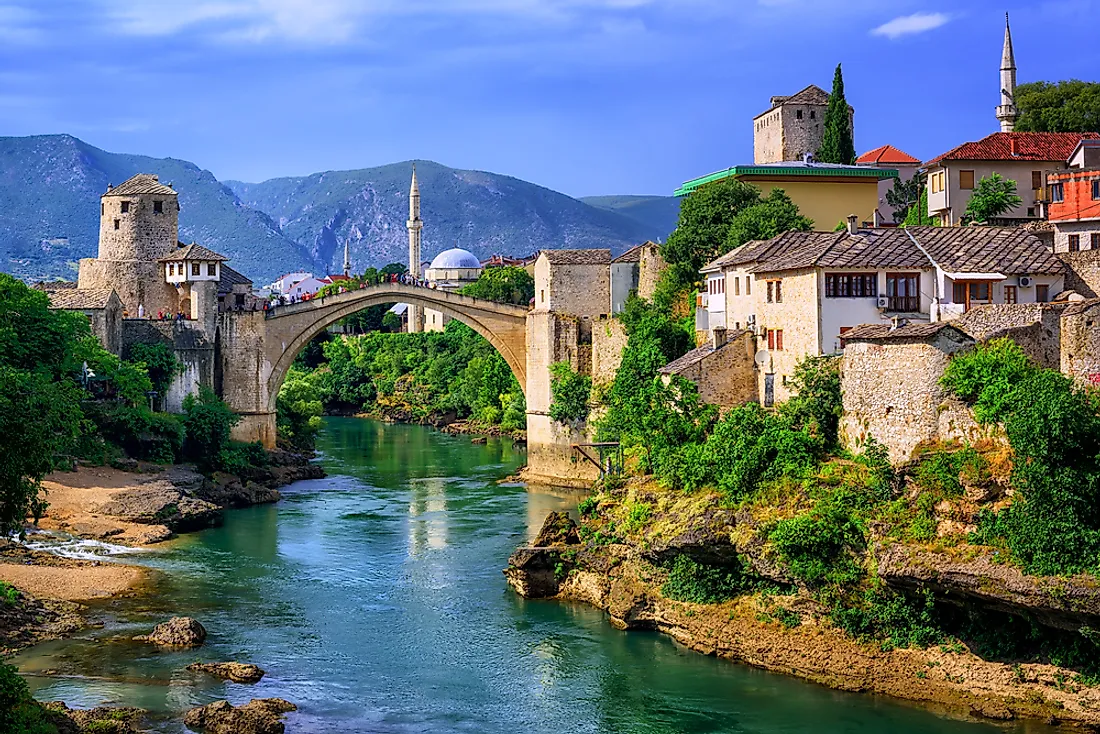
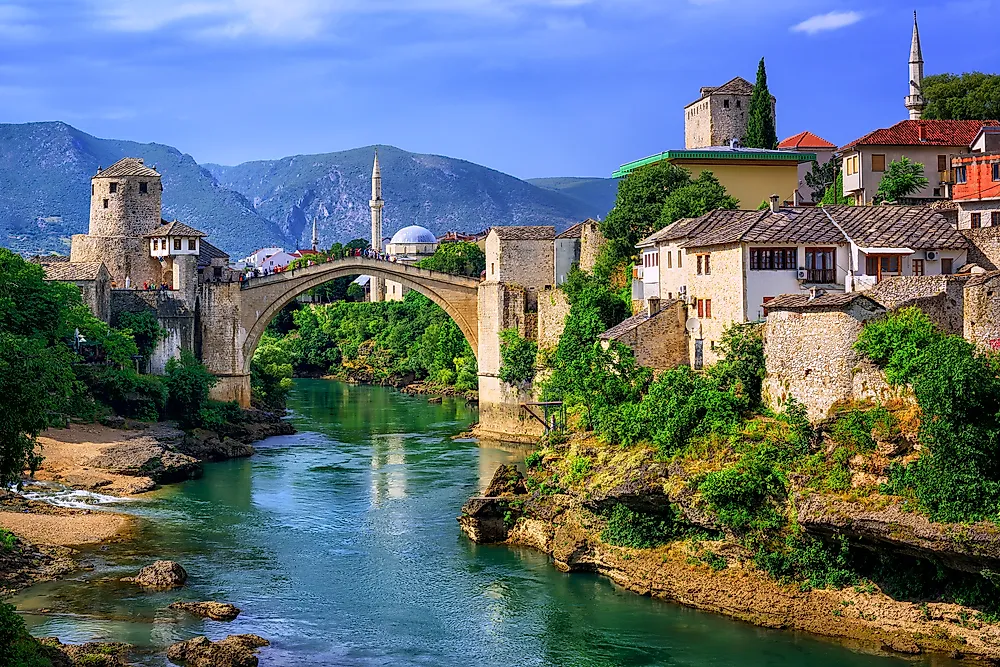
The Neretva flowing through the town of Mostar in Bosnia and Herzegovina.
The Neretva River running through Bosnia and Herzegovina is considered to be the coldest river in the world.
This river comes from high up in the Dinaric Alps and is composed of glacier runoff.
Various threats exist for the Neretva River, its surroundings and its life forms, including invasive species and the building of hydroelectric dams.
The coldest river in the world is most commonly cited as the Neretva, which flows through Bosnia and Herzegovina and into Croatia. The river, also known as the Narenta, makes up part of the larger Adriatic Basin region and empties into the Adriatic Sea. The river’s basin covers a total area of 4,010 square miles (10,386 square km). It is usually about 44 degrees Fahrenheit (7 Celsius) in the summer.
The Neretva begins in the mountains of the Dinaric Alps at 4,026 feet (1,227 m) above sea level, where it is formed by the runoff of three large glaciers and by an underground spring situated below the Jabuka Mountain. This high elevation contributes to its extremely cold temperatures, which average just above the freezing point. The cold temperatures of the river are concentrated in the Upper Neretva.
The Neretva runs a course of 140 miles (225 km), 129 miles of which flows through Bosnia and Herzegovina, over a base of limestone and dolomite rock that forms a system of caves and sinkholes. This geological feature means that the Neretva is considered a karst river and is the longest of its kind to flow through the eastern part of the Adriatic Basin. The river is remarkable for its clean, pure water and its deep greenish-blue color.
The Neretva River passing through canyons in Bosnia and Herzegovina. Image credit: goran_safarek/Shutterstock
Wildlife Of The Coldest River
The Upper Neretva and its surrounding area are home to numerous plant and animal species. In fact, approximately one-quarter of all European fish species are found in the river. Some researchers estimate that just over 10% of these fish are endemic to the region. Three examples of endemic fish are marble trout, Neretvan softmouth trout, and tooth trout. Each of these species belongs to the Salmonidae family and are also classified as endangered. Development in and around the river has resulted in significant habitat destruction, which has been identified as the primary reason for the endangered conservation status of these species.
Fishing in the Neretva River. Image credit: Zlatan Spahic/Shutterstock
Source: Amber Pariona in Environment